See what the numbers support.
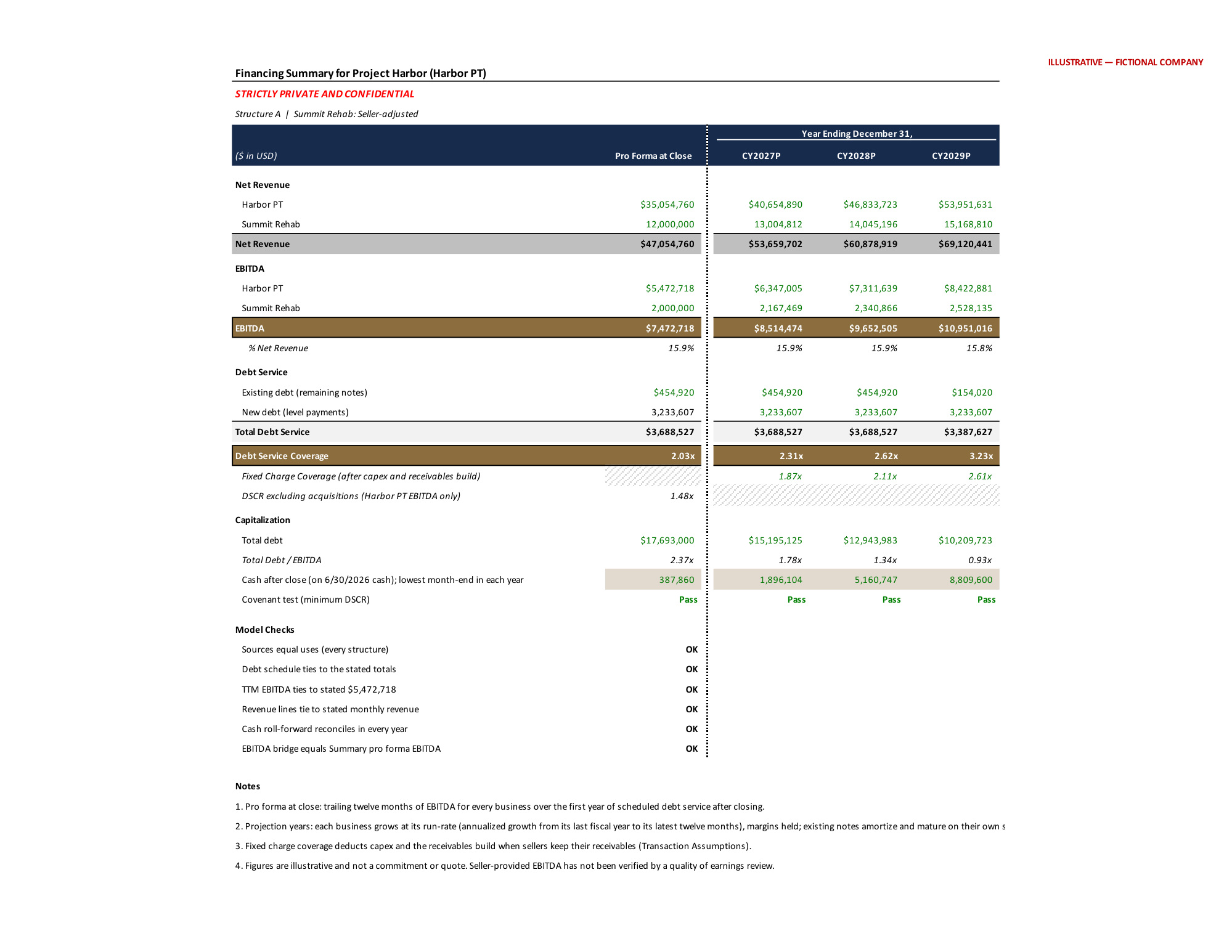
The review becomes a financing model you can inspect. Earnings, debt service and cash after closing sit together, so you can see how the proposed financing changes the business.
- Coverage after the new debt is added.
- Existing obligations that remain.
- Cash available after closing.
Built by software, checked page by page by a senior banker. Who reads your file.
Know what needs work before the file goes out.
We use the review to set the financing strategy and prepare the lender package. Resolve the open questions here, and lenders can spend their time assessing the request.
Build the package
The file supports a financing conversation. We build the model, presentation and teaser, then send the anonymous teaser, once you approve it, to the lenders that fit.
Change the ask
We explain whether a smaller amount, different repayment term or financing against assets could work.
Fix the specific issue
You get the obstacle in writing: missing financials, insufficient coverage, existing liens or another gap. You keep the memo.
Six questions. Answers you can check.
These checks shape the package and which lenders it goes to. You receive the reasoning in writing, with a lender match summary of how many lenders fit and what kinds; each conclusion leads back to a document, a calculation or a requirement.
- 01
What does the business really earn?
We reconcile the financials and separate recurring earnings from one-time items. Every add-back needs support. On an acquisition, the seller's adjustments are tested the same way before a lender relies on them.
Financial statements + tax returns
→ An EBITDA bridge the lender can check.
- 02
What will the new debt actually cost?
We model the interest and amortization of the proposed structure. If you do not have terms yet, we use the terms we expect that structure to price at and label the assumption beside the payment. A different structure means a different payment.
Amount + structure + expected terms
→ Annual debt service, with the assumptions beside it.
- 03
How much debt can the business carry?
We measure senior and total leverage against EBITDA, and fixed-charge coverage after the new debt, counting every obligation that stays on the books. If the ask is too large, we show the size the cash flow supports.
EBITDA + the full debt schedule
→ Leverage, coverage and a supportable amount.
- 04
What else could support the financing?
Receivables, inventory, equipment and contracted revenue may support an asset-based or split structure. We examine the assets, the customers who owe you and the liens already attached to them. Tight coverage changes the route; it does not answer every financing question.
A/R aging + assets + contracts
→ Alternative structures and what each requires.
- 05
Which lenders does the file fit?
We check the use of funds, industry, ownership and structure against each lender type's box: check size, leverage tolerance, sector and geography. A good company can still be a poor fit for a particular lender.
Ownership + use of funds + lender criteria
→ Fit issues to resolve before outreach.
- 06
Who should actually see it?
BRUNO matches the file to lenders by product, check size, sector and geography. A senior banker reviews the memo and the match before anything goes out. You approve the package before outreach, and by name each lender that asks for your company information.
The credit case + the lender book
→ A reviewed memo and a lender match summary: how many lenders fit, and what kinds.
The ratios a credit committee reads first.
For a company with $10M to $100M+ in revenue, lenders size debt on leverage and test it on coverage. The memo shows where your file lands on each, with the arithmetic beside it.
Senior leverage
How much of the debt sits first in line, and how much a senior lender will hold.
Total leverage
The whole capital structure, junior and seller paper included, against what the business earns.
Fixed-charge coverage
Whether earnings after capital spending and taxes cover interest, principal and leases, with room to spare.
Each lender sets its own limits, by structure and sector, and assesses more than these ratios. The rate, term, collateral and use of funds all affect the decision.
Written by Carmine Bruno, Managing Partner. Who reads your file →
Is the memo a loan approval?
No. It is our assessment of what the file can support and what needs work. Each lender makes its own credit decision. The value is knowing where the case is strong, where it is weak and which lenders are worth approaching.
Can I keep the review if I do not proceed?
Yes. You keep the underwriting memo and its calculations whether you place through Midas Partners, use another provider or decide not to borrow.
What if the numbers do not support the amount?
We test whether a smaller amount, a different amortization, a split senior and junior structure or financing tied to receivables, inventory or equipment could fit. If the information is incomplete or no workable structure is supported, we explain what needs to change.
Bring the numbers. We’ll build the case.
Send the financials and tell us what the financing needs to accomplish. We’ll identify the gaps, work through repayment and turn the supported case into a package for your approval.
Start with what you have
- Two to three years of financial statements
- Year-to-date P&L and balance sheet
- Current debt schedule
- The amount and what the capital is for