Six documents, one set of numbers.
Three go to lenders once you approve them. Three are for you: what we propose, what we found, and how many lenders fit and of what kinds. All six are built from the same model, so they never disagree.

A full model in Excel with live formulas: sources and uses, a monthly credit model, coverage, leverage, covenants and sensitivities.

The CIM: the business, the financing and the credit case, every figure pulled from the model.

A cover and one page under a codename, enough for a lender to decide whether to read on. Nothing that names you until you approve it.

Before anything goes out: the structures we would pursue, each costed, and where we expect the financing to price.
The underwriting: whether the payments are covered, what the business really earns, what secures the loan — the arithmetic shown, not a score asserted.
How many lenders in the book fit this file, and what kinds they are: lender types and counts, by check size, sector, geography and credit box. No names: you see a lender's name when it asks for your company information, and approve or decline it then.
The package top investment banks build on large deals. For companies with $10M to $100M+ in revenue, built in a day.
A financing model, a lender presentation built on it and a blind teaser are what the top M&A and restructuring banks prepare. Our founder learned to build them on those deals, working alongside those banks. At your size, an advisor’s analysts usually build them by hand over weeks, and those hours are in the fee. Here software builds them for yours, and a senior banker checks every page.
Project Harbor, below, is illustrative: a fictional company with invented figures, in the format we prepare for live files.
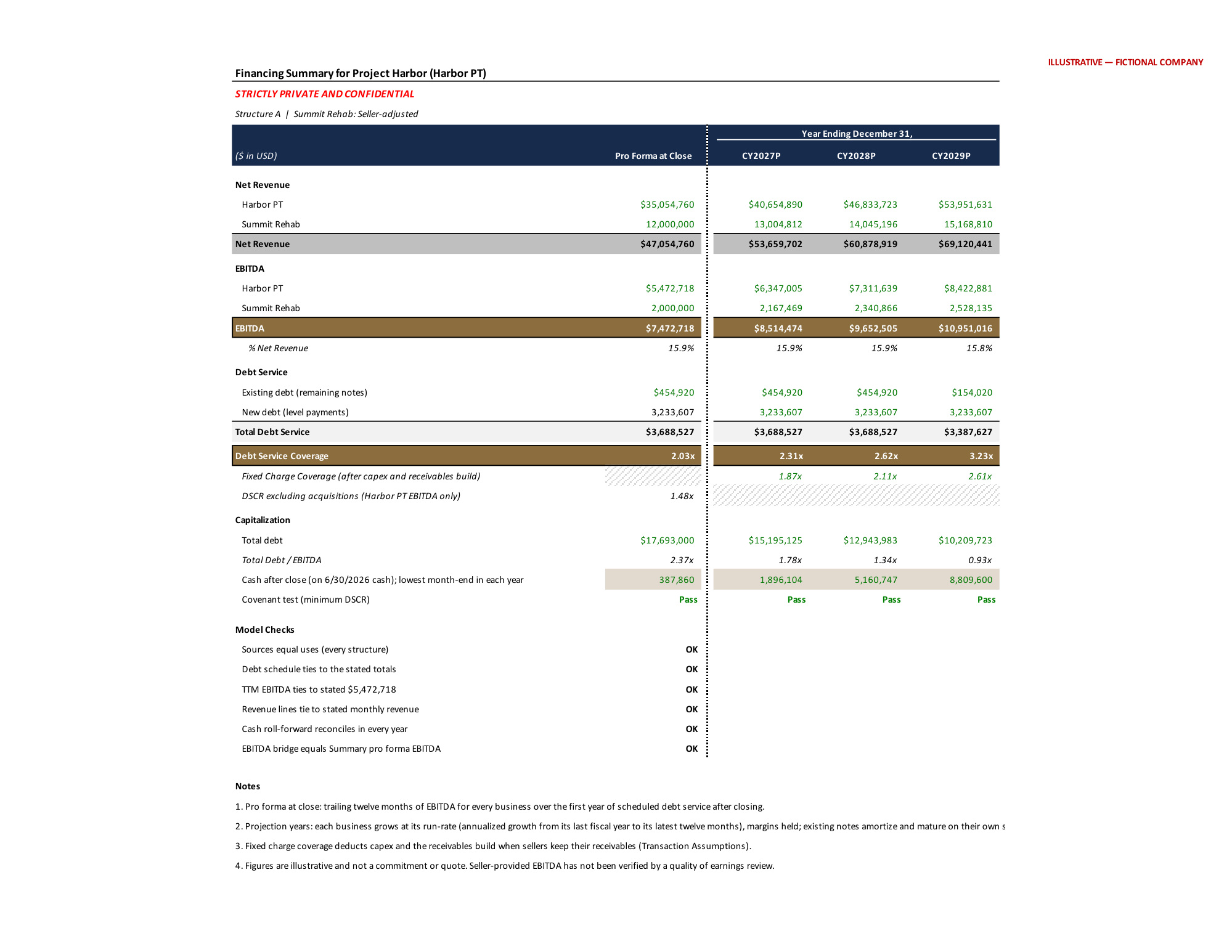
Pro forma coverage, leverage and cash after closing, with the model's six checks, on one page.
Open full sizeProject Harbor is invented: the company, the acquisition and every figure. Shown as we prepare them for live files.
One day to build your package. Once the documents are in.
Software builds the deal file from your documents, and from it BRUNO generates the model, the presentation, the teaser and your proposal. A senior banker reads every page before anything goes to a lender. Document collection, your approval, lender underwriting and closing are separate from package production.
On a live acquisition and refinancing this September, the proposal, the financing model, the 14-page lender presentation and the blind teaser were built in one day. Along the way the work found a seller earnings schedule that did not add up and a receivables build the client’s own numbers had missed.
Built to survive a credit committee.
One model feeds every document: each figure in the presentation, the teaser and your proposal is pulled from it, so they cannot disagree with it or with each other. It recalculates in Excel and must pass six checks before it leaves.
- Sources equal usesPASS
- Debt schedule ties to its totalsPASS
- Trailing EBITDA ties to the statementsPASS
- Revenue lines tie to monthly revenuePASS
- Cash reconcilesPASS
- EBITDA bridge equals the summaryPASS
Only numbers we computed
- “Dilution of 1.8% across the trailing twelve months”
- “Clean receivables”
A lender can check the first against the aging. If the file does not establish a number, it does not appear.
Some words never appear
A credit officer cannot check them, so they discount everything around them. Every teaser is checked for them before it goes out. Where the business has a strength, a number says it.
The banker. Not the analyst hours.
At a traditional advisor, analysts build these documents by hand over weeks, and those hours are in the fee. Here software builds them in a day and a senior banker checks every page. We don’t carry the analyst hours, so the saving passes through to you.
Nothing goes out until you approve it.
You see the teaser before any lender does. You approve by name each lender who asks for more. Your identity is disclosed only after a lender has expressed interest in the anonymous file, so a market survey never becomes a market rumour. That is clause four of the disclosure standard.